

What Makes Rubrics Tools That Students Use to Learn?
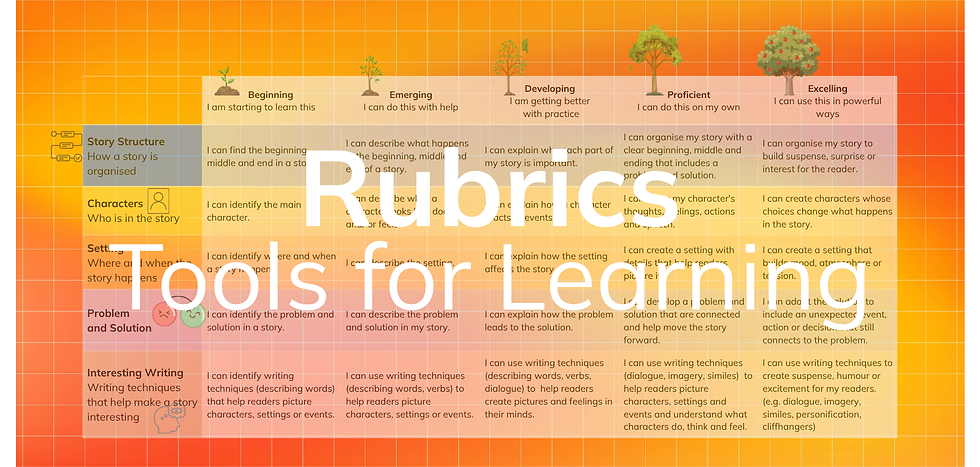
Rubrics are a familiar tool in many schools and classes. They sit alongside assessment tasks, appear in unit plans, and are often seen as an essential part of good assessment design. Educators create them with the best of intentions; to make expectations clear, promote consistency, and help students understand what quality work looks like.
In our work with schools, we support educators to build a shared understanding of:
why rubrics matter,
what high-quality rubrics look like,
how to design them, and
how to implement them in ways that genuinely improve learning.
Something that we embed in our work is deep consideration of this question:
What makes rubrics tools that students use to learn?
After working with schools and teachers across a wide range of contexts, we've noticed something. Many rubrics are thoughtfully designed, yet they don't always become powerful tools for learning once they're in students' hands. We can fall into the trap of assuming that because we've created them, students are using them in the ways we intended. Yet what we hope a rubric will do and what students actually experience can be very different. So perhaps it's worth pausing and taking a fresh look.
Think about a rubric you're currently using.
How do your students experience it?
How often do they genuinely come back to it?
Does it help them improve, or does it simply tell them where they sit?
Does it build independence, or does it reinforce dependence on teacher judgement?
These questions matter because rubrics are never neutral. Even when they aren't functioning as we intended, they're still teaching students something.
So, what are your rubrics actually doing for learners? Let’s explore that through these 5 questions:
What is its purpose?
Most rubrics begin with a clear purpose. What is the purpose of your rubrics?
supporting growth OR justifying grades
clarifying quality OR categorising students
guiding improvement OR something students look at only after they've received their mark.
We want to provide clarity, transparency and consistency. We want students to understand expectations and have a pathway towards success. But somewhere between designing the rubric and using it in the classroom, that purpose can quietly shift.
When that happens, students are still learning from the rubric, but perhaps not what we intended. So the question isn't whether your rubric is good. The question is: Is it doing the work you want it to do?
Is it supporting learning or simply labelling?
Start by looking closely at the language in one of your rubrics. What is it actually describing?
Is it describing what quality work looks like?
Can students clearly see how to improve?
Does the language communicate progress and development?
Or is it mostly sorting students into performance levels?
This distinction matters more than we often realise. When rubrics focus primarily on ranking achievement, many students stop reading once they've identified "their level" or answered the question “What mark did I get?”. The rubric becomes less about learning and more about classification. A learning-focused rubric helps students answer questions like:
What am I doing well?
What does quality look like?
What's my next step?
Is it providing feedback or justifying a grade?
It is also worth thinking about how students are using the rubric. For many students, the rubric appears at the end of the task/unit of learning attached to a grade. By then, the learning has already happened.
Ask yourself:
Do students use the rubric while they're drafting and during learning?
Does it shape peer feedback?
Is it part of conferencing and reflection?
Or does it mainly exist to explain the final judgement?
A useful test is this:
If grades disappeared tomorrow, would your rubric still be valuable?
Would students still use it to:
identify strengths
notice gaps
set goals
improve their work
decide what to do next?
The strongest rubrics act less like score sheets and more like learning companions, tools students return to repeatedly as they monitor, adjust and improve their work.
Does it create agency or dependence?
Sometimes rubrics can be difficult for students to use independently. The language is formal, abstract or overloaded with curriculum terminology, so students rely on the teacher to interpret what every descriptor means. When that happens, the rubric becomes something done to students rather than something used by students. Who is the rubric really written for?
A genuinely useful rubric enables learners to:
explain what quality looks like
self-assess
identify evidence in their own work
set goals
monitor progress
decide on realistic next steps.
This is where rubrics begin to foster learner agency. When students can confidently navigate the rubric on their own, they become active participants in improving their work rather than passive recipients of judgement.
Is it embedded throughout the learning?
Timing matters just as much as wording. Think about when students first encounter your rubric.
Before learning begins?
During the learning process?
Only after the task/unit is finished?
What about when it is revisited?
How often do students revisit it without grades attached?
Is it referred to during lessons?
Do students reflect against it over time?
Does it shape conversations about learning?
Rubrics that are woven into everyday learning send a powerful message: This is here to help you improve. Rubrics that appear only at the end often communicate something quite different: This is here to judge your performance. It might seem like a subtle difference, but for students it fundamentally changes the purpose of the rubric.
What Does a Learning-Focused Rubric Look Like?
The Table in Image 1 aims to capture what a learning-focused rubric prioritises in its design and use.
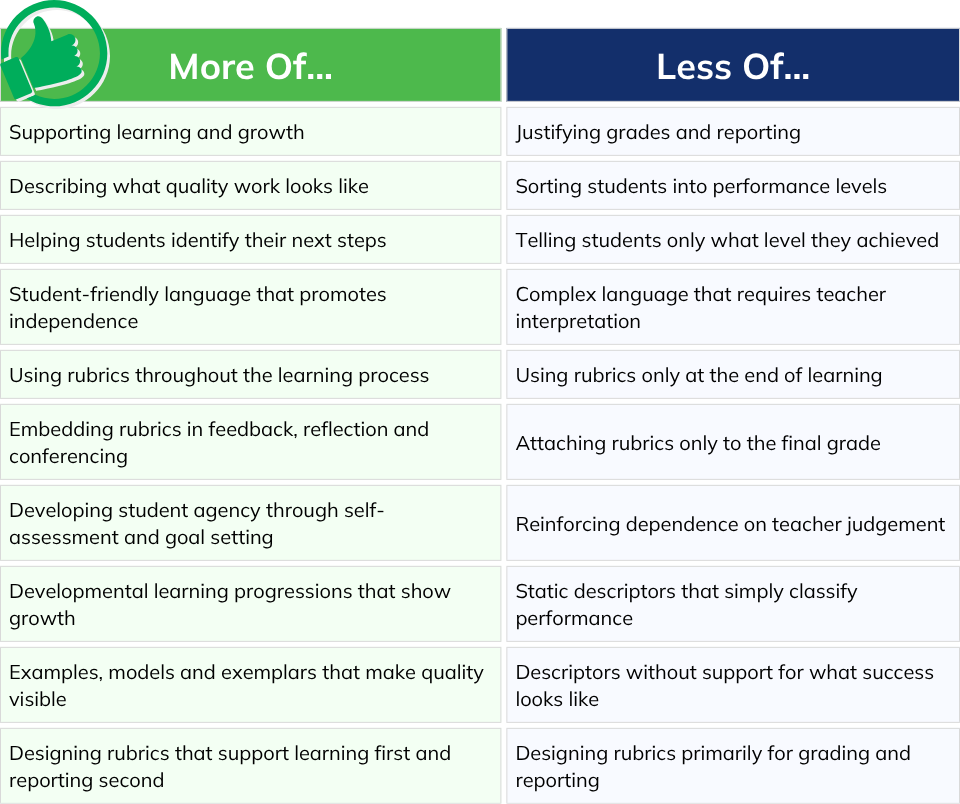
Image 1
Image 2 and Image 3 below illustrate what 'More of' can look like in practice. Rather than functioning simply as assessment tools, they are designed to support learning from the very beginning of the unit through to reporting.

Image 2

Image 3
Keeping rubrics anchored to learning
One of the most rewarding parts of our work with schools is seeing the shift that occurs when rubrics move beyond assessment and grading and become part of everyday learning. When teachers share a common understanding of quality, design developmental rubrics together, and deliberately teach students how to use them, they become tools that support conversations, reflection, feedback and growth.
Ultimately, the goal is that rubrics become tools that students use to learn.


Comments